Every State Banned Texting While Driving. 32,717 People Died Anyway.
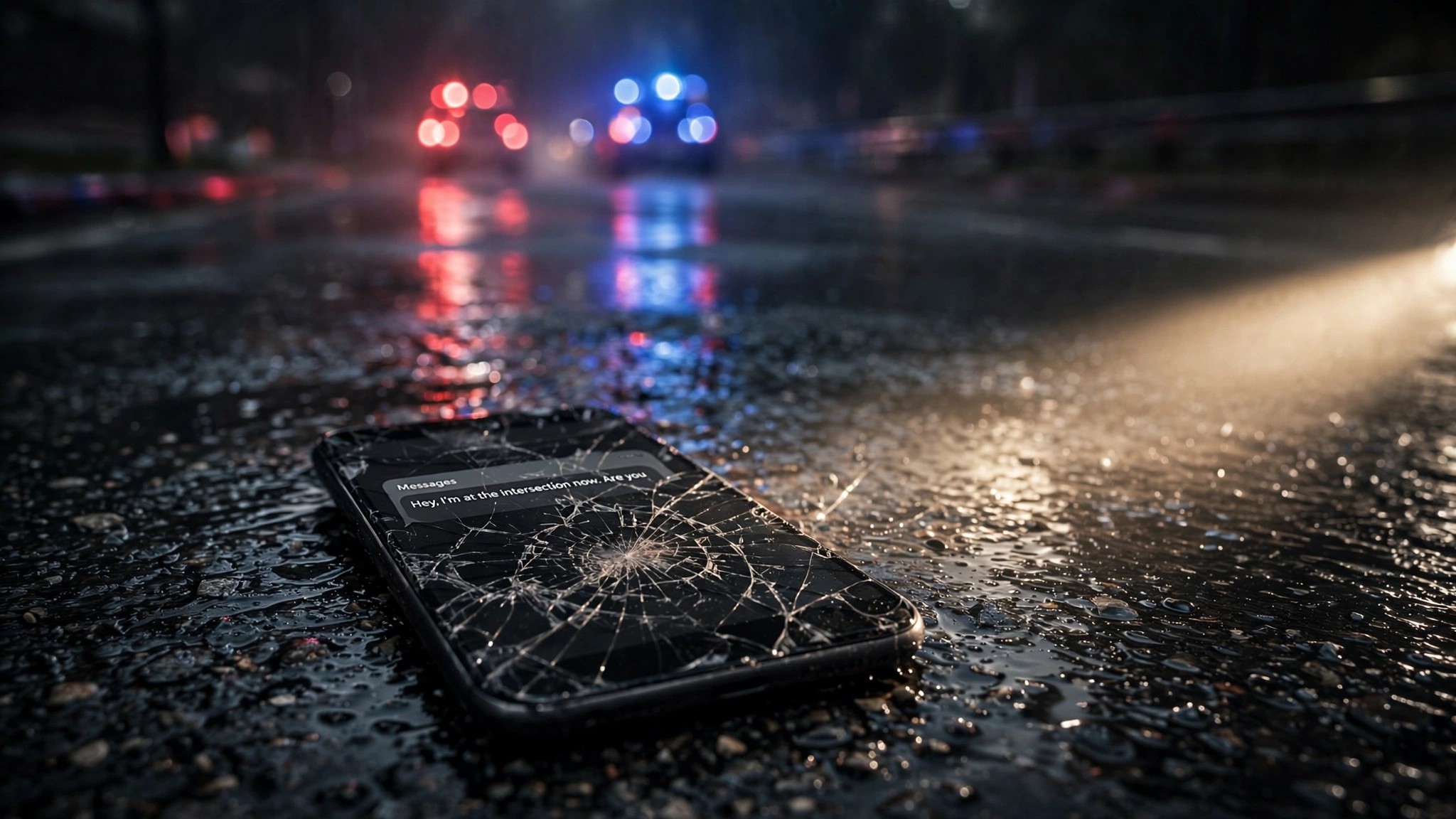
I ran the numbers, then I ran them again, and they refused to improve. Between 2015 and 2024, 32,717 people died in crashes where a driver was officially classified as distracted, according to NHTSA data.[1] In 2015, the annual count sat around 3,477; by 2024, it had fallen to 3,208. A decade of legislation, public awareness campaigns, celebrity PSAs, and Apple adding a driving mode to every iPhone, and America shaved off 269 deaths per year. That is a 7.7% improvement spread across ten years of effort.
A new study from Michigan State University and Universiti Putra Malaysia, published in the Journal of Safety Research in July 2025, explains why the number won't move.[2] Researchers Nischal Gupta, Megat-Usamah Megat-Johari, and Nusayba Megat-Johari analyzed state-level monthly fatal crash data from 2011 through 2021 using a two-way random effects negative binomial model, controlling for VMT, population, urbanization, speed limits, and enforcement intensity. Their conclusion lands like a gut punch: the effectiveness of cellphone driving bans decays after approximately two years. Bans work when they are new, when enforcement is visible, when drivers remember the headlines. Then habituation kicks in, the enforcement resources shift elsewhere, and behavior reverts.
Worse still: texting-only bans, the kind that 19 states rely on as their primary distraction policy, showed a positive correlation with cellphone-distracted fatal crashes.[2] Not neutral. Positive. The researchers found that states with comprehensive handheld bans combined with texting prohibitions saw the greatest safety benefit, states with handheld bans alone saw moderate benefit, and states with texting bans alone saw an association with more fatal distraction crashes than the baseline.
That mechanism is almost certainly concealment, and the behavioral logic is straightforward: tell a driver they cannot text, but permit them to hold the phone for calls, navigation, and everything else, and they will still text. They will simply do it with the phone wedged between their thighs or tucked below the steering column, eyes dropped further from the windshield for longer intervals, body contorted to hide the screen from passing patrol cars. A ban designed to keep eyes on the road instead redirects them to the footwell, and the risk scales with the redirect: Virginia Tech's naturalistic driving research found that texting increases crash risk by a factor of 6.1, with danger climbing in proportion to how long the driver's gaze leaves the forward roadway.[6] Comprehensive handheld bans work better because they eliminate the ambiguity entirely: the phone cannot be in your hand, period, regardless of what you claim to be doing with it.
The 19 states still operating under texting-only frameworks include Texas, Florida (which restricts handhelds in school and work zones only), North Carolina, Kentucky, Mississippi, Montana, and a dozen others.[3] These are not small states. Texas alone registered 4,427 traffic deaths in 2023.[4] North Carolina and Florida collectively accounted for thousands more. If the Gupta study's finding holds, the most common distraction policy in these high-fatality states isn't failing passively. It is generating a false sense of legislative accomplishment while behavioral incentives push distracted driving into more dangerous configurations.
Now overlay the two-year decay curve onto America's legislative timeline. Most states enacted their texting bans between 2009 and 2015. After 2018, comprehensive handheld bans started arriving in waves, with states like Georgia (2018), Minnesota (2019), Michigan (2023), Ohio (2023), Pennsylvania (2022), and Colorado (January 2025) joining the hands-free camp. Michigan's handheld ban, enacted in 2023, produced a 12.8% decrease in distracted driving crashes within its first year, according to Colorado DOT data citing Michigan's results.[5] That is a genuine, measurable improvement. But if the Gupta study's two-year decay pattern holds, Michigan should expect that 12.8% gain to erode by 2025 or 2026 unless enforcement intensity is sustained or increased.
The math collapses into a depressing, predictable cycle: a state passes a cellphone law, distraction crashes drop for a year or two as novelty and enforcement visibility suppress behavior. Then habituation erodes the gains, distraction deaths creep back toward baseline, and the legislature moves on to the next issue, satisfied that the problem has been addressed. Meanwhile, 3,208 people die per year in the official count, which NHTSA's own researchers have acknowledged is a dramatic undercount because distraction is notoriously difficult to identify in post-crash investigations when the distracted driver is dead and the phone is destroyed.[1] Independent estimates place the real distraction-involved death toll closer to three times the official figure, which would put it somewhere north of 9,000 per year, or roughly one in four traffic deaths in America.
The strongest objection to this interpretation: maybe the flat trendline is actually masking real progress. Smartphone penetration in the U.S. went from roughly 35% in 2011 to over 90% by 2024. Screens got bigger, apps got stickier, TikTok trained an entire generation to consume content in short bursts ideally suited to red-light scrolling that extends through green lights. If phone usage while driving increased threefold while deaths held roughly constant, the bans may have prevented an enormous spike. What you cannot know is the counterfactual, a world where distraction deaths scaled linearly with phone adoption, is unknowable but genuinely plausible, and this study cannot rule it out.
Nor can it rule out regional confounding. States with worse baseline crash rates and weaker enforcement cultures may have been the ones most likely to adopt texting-only bans as a politically expedient compromise, making the positive correlation a selection effect rather than a causal one. Gupta and colleagues used state-specific random effects to control for time-invariant state characteristics, but unobserved variables correlated with both policy choice and crash outcomes can still contaminate the estimate.
These are honest limitations, and the researchers acknowledge them explicitly. But the core finding, that ban effectiveness decays after two years, is robust across multiple model specifications and aligns with enforcement decay research from seatbelt and DUI law studies stretching back decades. The phenomenon is not unique to cellphone bans. It is a fundamental property of behavioral regulation: absent sustained visible enforcement, deterrence erodes.
NHTSA's 2024 data shows 39,345 total traffic deaths and a fatality rate of 1.20 per 100 million VMT, the lowest since 2019 but still 6% above the pre-COVID seven-year average of 1.13.[4] The agency is celebrating an 11th consecutive quarterly decline while acknowledging, in the same press release, that America's traffic fatality rate remains high relative to peer nations. Distracted driving sits inside that gap like a tumor that has stopped growing but refuses to shrink, accounting for 8% of the fatal crashes NHTSA can identify and probably 20-25% of the ones it cannot.
If you live in one of the 19 states without a comprehensive handheld ban, contact your state representative and ask why your distraction policy is the type that research associates with more fatal crashes, not fewer. If you live in a state that passed its handheld ban more than two years ago, understand that the law's behavioral effect has likely decayed to near-baseline levels and your safety depends on your own discipline, not the statute. Mount your phone on the dash if you must use navigation, use voice controls for everything else, or better yet, put it in the glove box. Nobody has ever died because they missed a text. Roughly 3,200 people per year die because somebody didn't.
Sources & References
- NHTSA, Distracted Driving, 2024 data. 3,208 killed, 315,000+ injured; 32,717 deaths 2015–2024. nhtsa.gov
- Gupta, N., Megat-Johari, M.-U., & Megat-Johari, N. (2025). “Evaluating the impacts of cellphone use policies on cellphone-distracted fatal crashes.” Journal of Safety Research, 94, 329–339. PMID: 40930647. pubmed.ncbi.nlm.nih.gov
- Autoblog / Governors Highway Safety Association. State hands-free driving law tracker, updated Aug 2025. 31 states + DC with full handheld bans; 19 without. ghsa.org
- NHTSA, 2024 Traffic Fatality Early Estimates. 39,345 deaths; fatality rate 1.20/100M VMT. 2023 final: 40,901 deaths. nhtsa.gov
- Colorado DOT, “Heads up, Colorado! New 2025 law bans holding phones while driving.” Cites Michigan’s 2023 handheld ban producing a 12.8% first-year decrease in distracted crashes. codot.gov
- Dingus, T. A. et al. (2016). Driver crash risk factors and prevalence evaluation using naturalistic driving data. Proceedings of the National Academy of Sciences, 113(10), 2636–2641. Via NHTSA “Understanding the Problem.” nhtsa.gov