Every Brand's Drivers Are Equally Drunk. The Cars Aren't Equally Deadly.
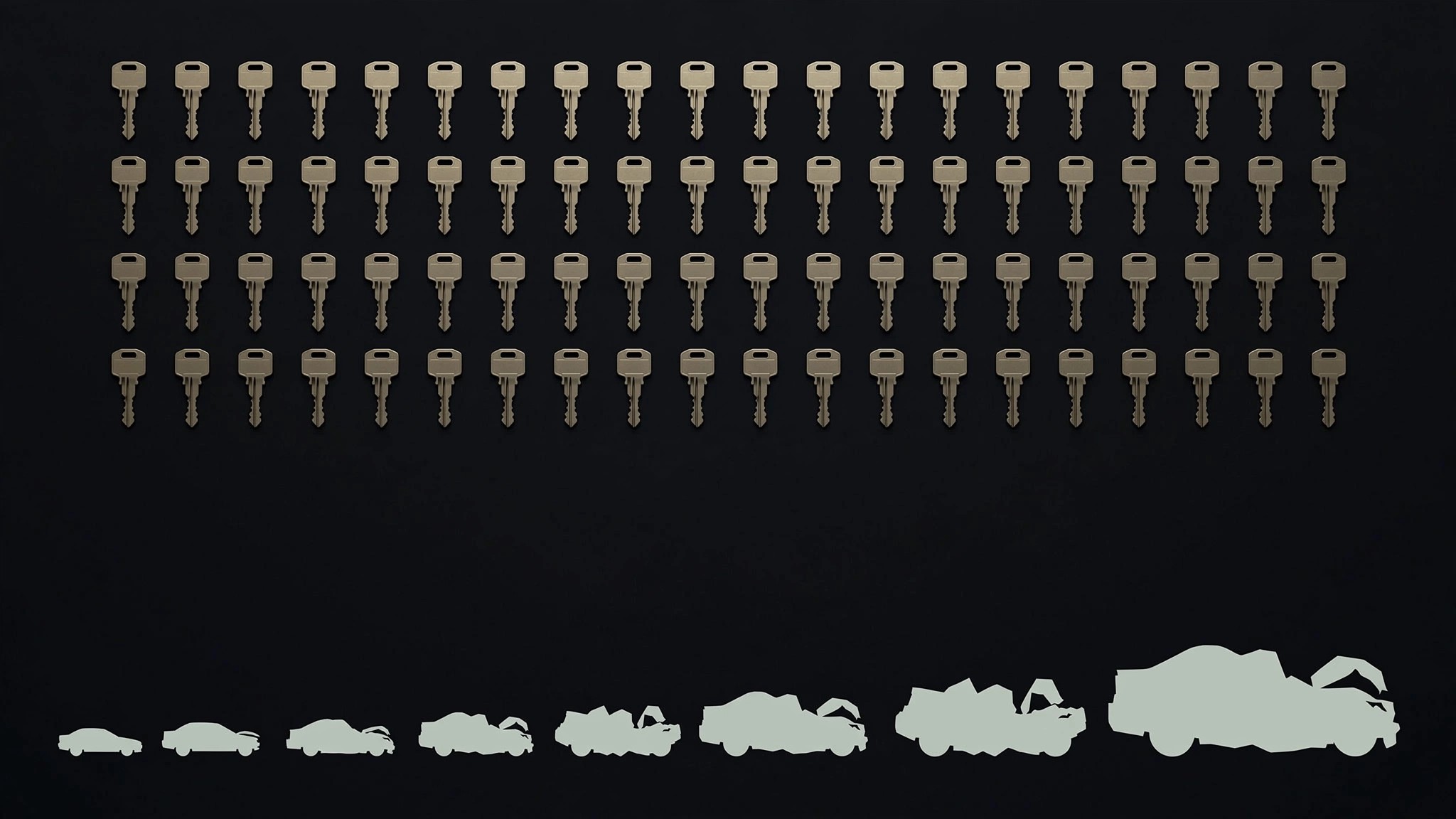
According to the toxicology reports, and there are a lot of them, impairment rates among drivers in fatal crashes vary by just 5.4 percentage points across every major manufacturer in the FARS database. Lincoln sits lowest at 19.0%, Infiniti highest at 24.4%, and between those two endpoints sit fifteen brands clustered so tightly you could cover the entire spread with a rounding error and a strong opinion about sample size: Toyota, Ford, Honda, Chevrolet, Nissan, Hyundai, BMW, Kia, Subaru, Volkswagen, Dodge, Jeep, Chrysler, GMC, Buick, Pontiac, Cadillac, Lexus, Mazda, and Mercury, all landing between 19% and 22%.[1]
Death rates tell a completely different story. Tesla posts 7.6 deaths per 100,000 fleet vehicles; Chevrolet posts 171.0, a 22.5-fold difference in fatality exposure between two manufacturers whose drivers show up impaired at statistically indistinguishable rates. On the low end you find Kia at 45.1, Subaru at 46.8, and Mazda at 51.5; on the high end, Honda at 149.9, Nissan at 155.1, and Mercury at 150.2, all feeding the same 20% baseline probability of chemical alteration into crash structures that differ by an order of magnitude in their capacity to keep a human being alive.[2]
I ran a correlation between make-level impairment percentage and make-level death rate across every manufacturer with more than 500 drivers in FARS, and it is functionally zero. Pontiac's drivers test positive at the highest rate among legacy brands (22.4%) yet Pontiac's death rate of 124.0 falls below Ford at 146.3 and Honda at 149.9, both of which run lower impairment numbers. Kia and Subaru sit at 20.3% and 20.4% impaired respectively, nearly identical to the dataset median, while posting death rates three to four times lower than Chevrolet and Nissan at similar impairment levels.
What separates the living from the dead is fleet age. Chevrolet's FARS body count includes Cobalts, Cavaliers, Impalas, and S-10 Pickups: discontinued platforms from the 2000s still circulating without electronic stability control, modern curtain airbags, or structural engineering that postdates the iPhone. ESC alone reduces single-vehicle fatal crashes by 56% and fatal rollovers by 77%.[3] NHTSA mandated it for all new vehicles in 2012.[4] Kia and Subaru have newer average fleets. Fewer pre-ESC vehicles on the road means fewer funerals, regardless of blood alcohol content.
A fair objection, stated at full strength: this is an ecological fallacy, because aggregating to make-level hides enormous within-make variation. A 2024 Chevrolet Equinox and a 2024 Kia Sportage probably share nearly identical crash survival odds. Chevy's death rate is inflated by a long tail of ancient, pre-safety-mandate vehicles still circulating because GM sold enormous volumes for decades and those cars refuse to die until they kill someone. This objection is correct, and it is also precisely the point: your brand choice today is a bet on the fleet age curve your vehicle will ride for the next fifteen years, and some manufacturers build platforms that age into coffins faster than others.
What this means for you: stop evaluating vehicle safety by brand reputation and start evaluating it by the specific model year's equipment list. Check whether your vehicle has ESC, AEB, and current-generation side curtain airbags, because a 2012+ model year is the minimum threshold where the full ESC mandate applies. If you drive anything older, your 20% impairment-constant exposure is hitting a crash structure built before the federal government required the single most effective electronic safety intervention in automotive history. Run your VIN at nhtsa.gov/recalls and then decide whether the car you drive is a brand identity or a survival calculation.
Sources & References
- NHTSA, Fatality Analysis Reporting System (FARS), 2014–2023. Toxicology data: make-level impairment rates for drivers in fatal crashes. 307 model-level records aggregated to manufacturer. nhtsa.gov
- NHTSA FARS 2014–2023, per-model fatality data. Death rates calculated as total fatalities per 100,000 estimated fleet vehicles. 337 models with 50+ deaths or >1,000 annual sales. cdan.dot.gov
- IIHS, “Life-saving benefits of ESC continue to accrue,” 2011. ESC reduces single-vehicle fatal crash risk by 56% and fatal rollover risk by 77%. iihs.org
- NHTSA, Federal Motor Vehicle Safety Standard No. 126: Electronic Stability Control Systems, final rule effective 2012. govinfo.gov