1.2 Million Cars Recalled Because Their Gas-Saving Features Catch Fire
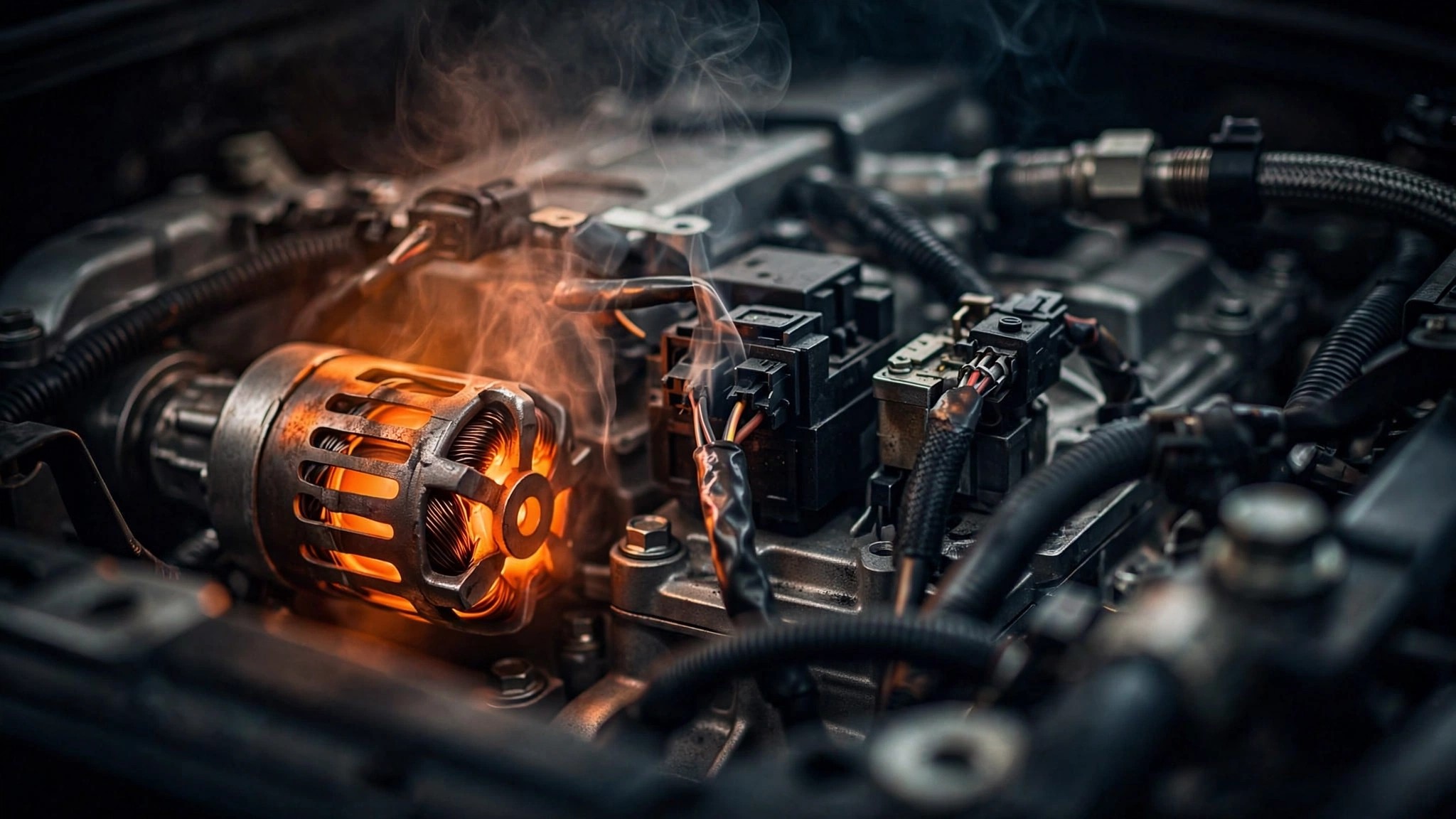
Your car's engine shuts off at every red light to save you a nickel in gas, and across three automakers and 1.2 million vehicles, that fuel-saving hardware is catching fire. Not because of the engine or the fuel system, but because of the gadgetry bolted on specifically to squeeze another mile per gallon out of regulatory compliance.
Start with Hyundai and Kia, who told roughly 90,000 owners in June 2026 to park outside and away from structures.[1] The defect lives in the transmission oil pump electronics of their "Idle Stop and Go" system, the feature that kills your engine at every stoplight and restarts it when you lift off the brake. Electronic components overheat, cause "localized melting," and the whole assembly becomes a fire starter. Hyundai logged four thermal incidents and Kia logged six melting events, and while nobody has been hurt yet, "park away from buildings" is not a phrase that inspires confidence in the engineering.
BMW's problem is mechanically different but spiritually identical. The Valeo-supplied starter motor in 87,394 vehicles from the January 2026 recall alone wears itself out because start-stop systems cycle it dozens of times per trip instead of once.[2] Metallic debris builds up in the electrical relay chamber from excessive abrasion, shorts out, overheats. BMW has recalled vehicles for this exact defect three times now: 200,000 units in an initial wave, 145,000 in October 2024, and another 87,394 in January 2026.[3] A traditional starter motor fires once when you turn the key and then sits idle for the rest of the drive. A start-stop starter fires at every red light, every traffic slowdown, every parking lot crawl. An urban commuter might accumulate 30 to 50 start cycles per day versus two to four with a conventional setup, a tenfold increase in thermal stress that three separate recall campaigns suggest nobody at Valeo or BMW adequately stress-tested.
Stellantis completed the trifecta in April 2026 by recalling 700,000 vehicles globally across eight brands: Alfa Romeo, Citroën, DS, Fiat, Jeep, Lancia, Opel/Vauxhall, and Peugeot.[4] Their 48-volt Belt Starter Generator replaces the traditional alternator and starter to enable mild-hybrid fuel savings. In the recalled cars, the gasoline particulate filter pipe sits too close to the BSG's pole protection cap. Contact between them allows water infiltration, which creates an electrical arc, which causes overheating, which causes fire. A 30-minute clearance adjustment fixes the problem, but the fact that 700,000 cars rolled off assembly lines with insufficient clearance between a hot exhaust component and a high-voltage electrical component suggests the quality control process was as insufficient as the gap itself.
Count it up: 90,000 from Hyundai/Kia, 432,000-plus from BMW across three waves, 700,000 from Stellantis. That is 1.2 million vehicles whose fire risk traces directly to hardware that exists solely because CAFE standards and EU CO2 regulations pushed automakers to shave fractions off their fleet fuel consumption numbers. Every one of these technologies shipped because regulators demanded better mileage. Nobody demanded that the mileage hardware not burn the car down, apparently.
The strongest counterargument is statistical, and it is worth stating at full strength. Ten thermal incidents out of 90,000 Hyundai/Kia ISG vehicles is a 0.01% rate. NHTSA estimates roughly 174,000 vehicle fires occur annually in the U.S. from all causes,[5] and these fuel-saving fire recalls may be adding marginal risk to an already substantial baseline rather than creating a new category of danger. That is fair, and it matters, but three independent automakers using three unrelated fuel-saving technologies all producing the same failure mode suggests the problem is architectural, not incidental. When you add complexity to meet a regulatory target, and that complexity introduces fire risk that the original system never had, the question is whether the regulatory framework accounts for the safety cost of its own mandates, and right now it does not.
What this analysis cannot tell you: how many vehicle fires are already attributable to fuel-saving subsystems that were never recalled, either because the fire destroyed the evidence or because the investigation attributed it to "electrical" without tracing it to a specific start-stop or mild-hybrid component. NHTSA's fire investigation taxonomy does not break out fuel-economy hardware as a cause category, so we are counting recalls rather than fires, and the actual toll could be higher.
If you own a 2020–2026 vehicle with Idle Stop and Go, auto start-stop, or a mild-hybrid badge, check your VIN at nhtsa.gov/recalls today. If your vehicle has a button that disables start-stop, pressing it until you have confirmed there are no active recalls is a reasonable precaution that costs you nothing but a few cents of extra gas. If your car is under active fire recall and you are parking in an attached garage, stop doing that immediately. The fuel savings are not worth the house.
Sources & References
- CNN, “Hyundai and Kia warn drivers of 90,000 vehicles to park outside due to fire risk,” June 7, 2026. cnn.com
- Carscoops, “Over Half A Million BMWs Recalled For Fire Risk, And Toyota’s Caught In It Too,” Feb. 2026. carscoops.com
- Fast Company, “BMW and Toyota recall more than 87,000 cars over fire risk tied to starter motor,” Jan. 30, 2026. fastcompany.com
- Autocar UK, “Stellantis recalls 44,000 UK cars due to fire risk,” April 2026; 700,000 vehicles globally. autocar.co.uk
- NHTSA, Traffic Safety Facts: Vehicle Fires. nhtsa.gov