Three Recalls, One Chemistry Lesson Your Car Failed
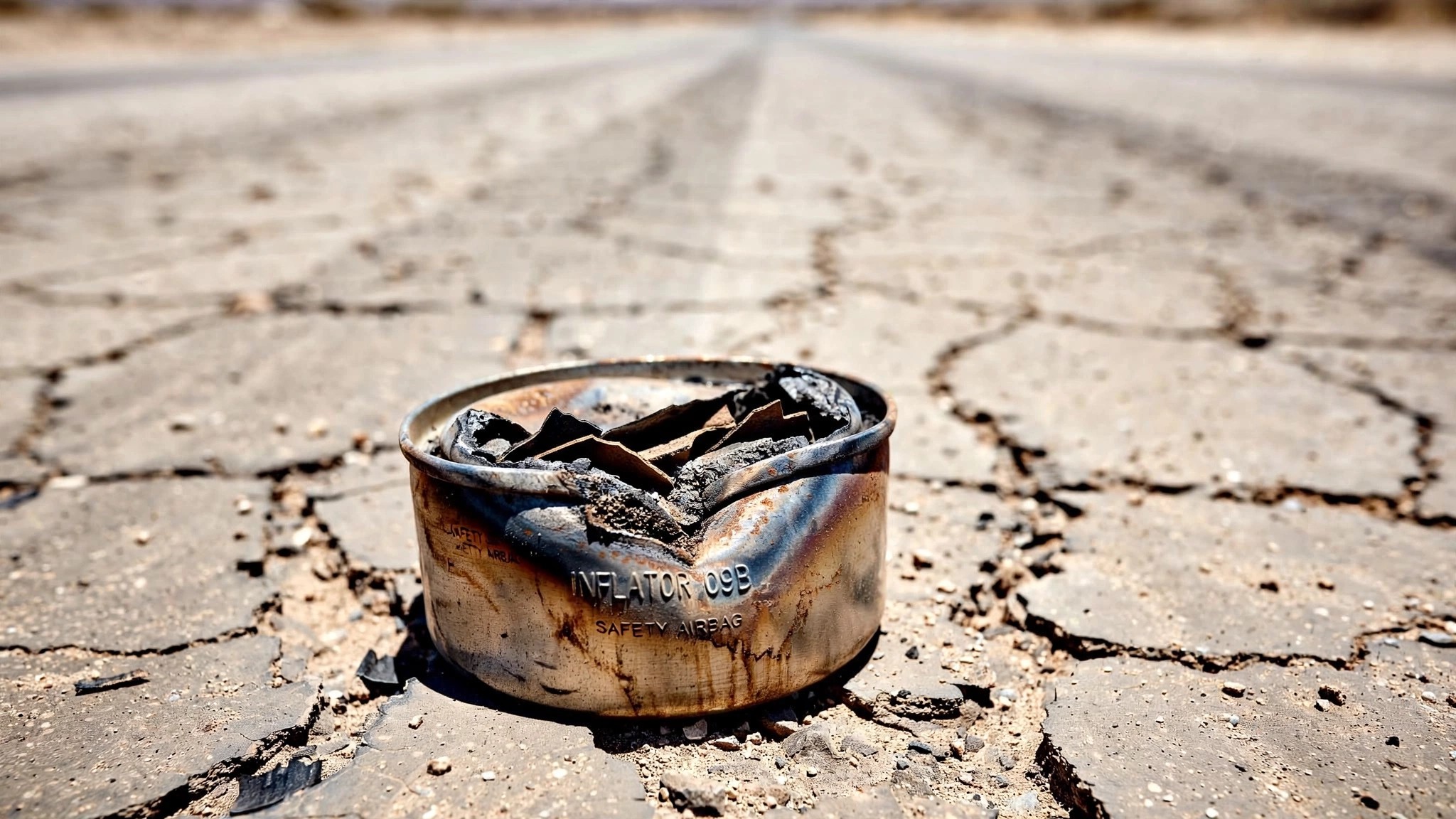
A seatbelt pretensioner in a Ford Expedition locks up on a Tuesday in August because its propellant corroded from the inside out. A moonroof on a Subaru Forester separates from the frame at highway speed because the adhesive primer wasn't there when the bond needed it. A Takata airbag inflator in a Honda ruptures during deployment, firing steel fragments into an occupant's chest, because ammonium nitrate absorbed moisture through a bad seal and cracked apart over five Texas summers. Three components, three suppliers, one mechanism: heat breaks the chemistry that was supposed to save your life.
Ford disclosed in June 2026 that 419,967 Expeditions and Lincoln Navigators from model years 2018 through 2022 need their seatbelt retractor pretensioners replaced. The propellant inside the pretensioner, supplied by ZF Lifetec, degrades after repeated exposure to high temperatures, yielding corrosive byproducts that eat through the squib pin and bridgewire.[1] Eventually the corroded circuit trips, the pretensioner fires when nothing is happening, and your seatbelt cinches tight and stays there, unable to retract or extend, unable to do the one job you need it to do when something actually happens. Ford has recalled these vehicles three times now for the same defect. ZF's tier-2 supplier only reformulated the propellant and stabilizer in February 2022.[2] Twelve people have been injured.
If this sounds familiar, that's because it should. Takata's ammonium nitrate airbag inflators killed at least 27 people in the United States and injured hundreds through the exact same failure pathway: a propellant that couldn't tolerate thermal cycling.[3] Takata's own 1999 patent documents warned that ammonium nitrate was "thermally unstable" and "might even blow up" after temperature cycling through a phase change at roughly 90°F.[4] No other major inflator manufacturer touched the stuff. Autoliv, TRW, and Key Safety Systems all used guanidine nitrate, a compound with better thermal tolerance. Takata chose ammonium nitrate because it was cheaper. Over 67 million vehicles were recalled in the U.S. alone, and the recall is still active a decade later.
Webasto Roof Systems rounds out the trilogy with 69,663 Subaru Foresters recalled in June 2026 after moonroof glass panels began separating from their frames at speed.[5] Webasto has been supplying panoramic roof assemblies that shed their glass for at least sixteen years across multiple automakers, a pattern The Crash Report documented last week.[6] Adhesive bonding in automotive roof assemblies depends on proper primer application and long-term chemical stability under thermal stress. When the primer is absent or insufficient, the adhesive bond degrades with cumulative heat exposure until the glass has nothing holding it to the frame but inertia and optimism.
All three share a regulatory blind spot. Automotive safety component testing protocols still rely on accelerated aging regimes that compress decades of thermal exposure into weeks or months. Those regimes capture average thermal loads reasonably well. What they miss is cumulative thermal cycling: repeated expansion and contraction at the molecular level causing microcracking, moisture ingress, phase transitions, and corrosion that accelerated steady-state heating doesn't reproduce. Components pass the test. Then they spend seven years in a Phoenix parking lot, and the chemistry fails in ways the test was never designed to catch.
This analysis doesn't prove these are the same failure. They're genuinely different engineering problems from different suppliers using different chemistry, and attributing all three to "heat" oversimplifies the specific mechanisms. Takata's problem was a fundamentally unsuitable propellant compound; ZF Lifetec's is a propellant-stabilizer formulation that corrodes under heat; Webasto's is a manufacturing quality control failure in primer application. The strongest version of the counterargument is that these are three separate defects with three separate fixes, and no systemic intervention addresses all three at once. Fair enough. But the meta-pattern holds: three of the five most critical safety systems in a modern vehicle rely on chemical reactions or chemical bonds that degrade under the thermal conditions those vehicles actually experience, and nobody in the regulatory or testing ecosystem is measuring for cumulative thermal degradation at the component level across the full vehicle service life.
Check your VIN at nhtsa.gov/recalls, because every one of these failures is trackable. If you drive a 2018–2022 Expedition or Navigator, this is the third recall for the same part; vehicles "repaired" under earlier recalls still need the new fix.[7] Ford's remedy parts won't be available until August. If you drive a 2026 Subaru Forester with a panoramic moonroof, check whether your VIN falls within the affected production dates. If your vehicle contains unrecalled Takata inflators and you park it outside in Texas, Florida, or Arizona, the propellant inside your airbag is aging faster than NHTSA's phased recall schedule assumed. Thermal degradation is patient, but your safety systems are not.
Sources & References
- NHTSA, Recall No. 26S34, Ford Expedition/Lincoln Navigator seatbelt retractor pretensioner recall, May 2026. nhtsa.gov
- autoevolution, “Ford Recalls 419,967 Expedition and Lincoln Navigator Vehicles for Seatbelt Retractor Issue,” June 2026. autoevolution.com
- NHTSA, Takata airbag inflator recalls, ongoing since 2014. nhtsa.gov
- U.S. District Court, S.D. Florida, Case 1:15-md-02599-FAM, Takata Airbag MDL, Document 1895 (July 2017): Takata patent documents (1995, 1999) acknowledging thermal instability of ammonium nitrate propellant.
- NHTSA, Subaru Forester/Forester Hybrid moonroof recall, May 2026. nhtsa.gov
- The Crash Report, “One Supplier Has Been Making Roofs That Fly Off for Sixteen Years,” Rex Driverton, June 2026. vehicle-safety.org
- Consumer Reports, “Ford Expedition and Lincoln Navigator Recalled to Fix Seat Belts,” June 2026. consumerreports.org