A $20 Chip Would Have Saved Them: The TikTok Theft Epidemic Hiding in FARS Data
Seventy-six people died in 2021 Kia Fortes across the FARS database, and then the 2022 model year came along and killed 14, a number so much lower it looks like a typo until you understand what changed. Same platform, same crash structure, same airbags, same sedan that nobody writes breathless reviews about. Only one meaningful difference separates those two model years: a component that costs less than a decent lunch, an electronic engine immobilizer.
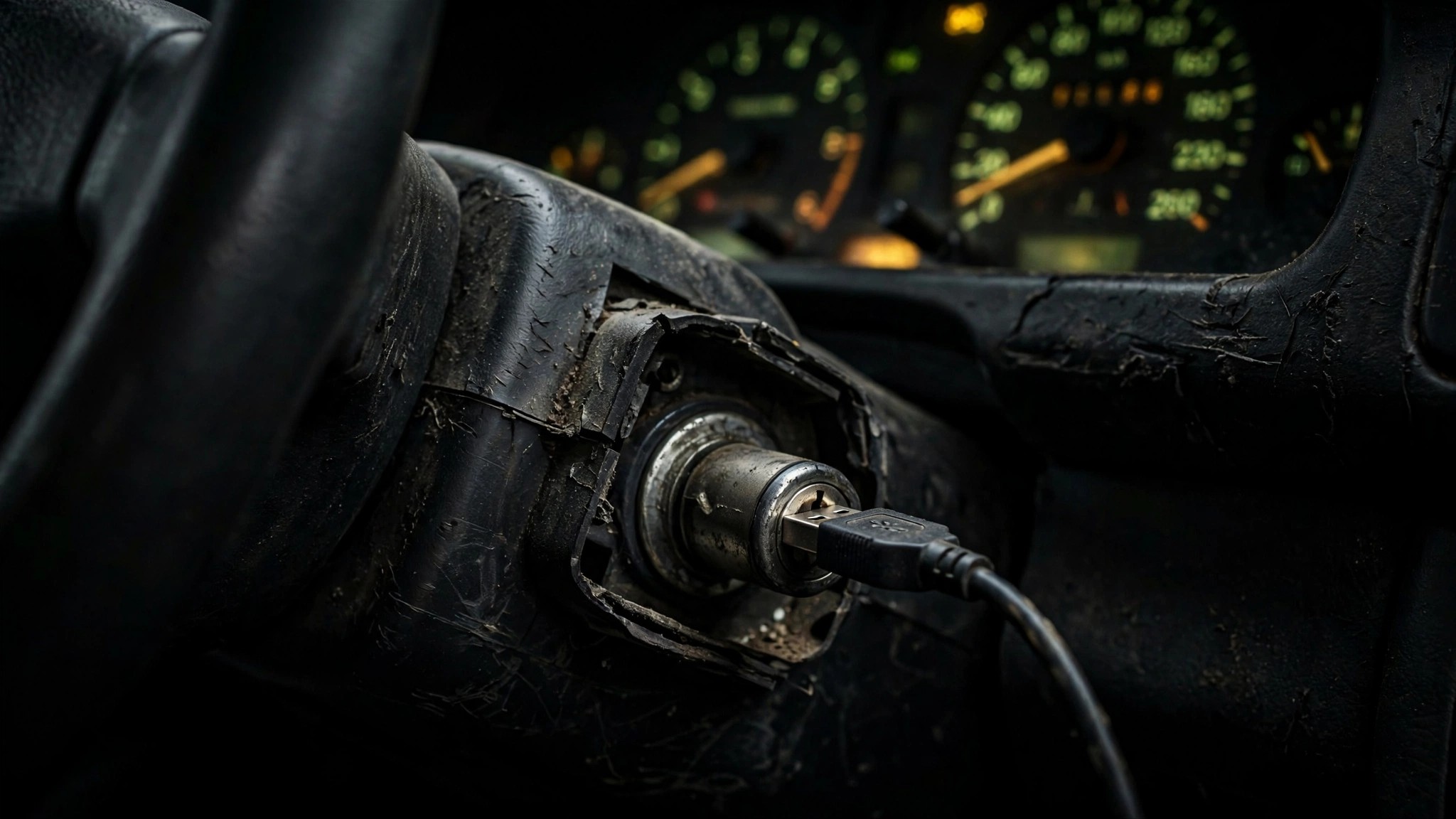
In July 2022, a TikTok user posted a video showing teenagers how to steal certain Kia and Hyundai models with a USB cable and a screwdriver, and no special skills were required because the vehicles lacked immobilizers, the electronic handshake between key and engine that has been standard on 96% of American cars since 2015.[1] Only 26% of Hyundai and Kia vehicles had one. Within months, theft claims for the two brands exploded from 1.0 per 1,000 insured vehicles to 11.2 per 1,000, an increase of over 1,000%.[2] Chicago saw thefts spike 800%. In the first four months of 2023, New York City logged 977 Hyundai and Kia thefts, up from 148 the same period the year before.[3]
NHTSA confirmed at least 14 crashes and eight fatalities directly linked to the challenge.[4] That number is almost certainly an undercount, because FARS does not tag whether a vehicle was stolen at the time of a fatal crash, and not all jurisdictions report theft status consistently. But the federal data reveals the epidemic's shadow through a method nobody else has published: comparing model year death curves between vehicles that lacked immobilizers and vehicles that always had them.
Run the comparison yourself with the publicly available FARS extract. For every mainstream sedan with an immobilizer (the Toyota Camry, Honda Civic, Toyota Corolla), deaths decline steadily from the 2019 model year to the 2023 model year, which is exactly what you would expect as newer cars spend fewer cumulative years on the road within the dataset window. A 2019 Camry accumulated 122 deaths over roughly four years of FARS exposure; a 2023 Camry accumulated 21 over roughly one year, and every year in between falls on a smooth downward line without a single anomaly.
Now run the Kia Forte, the car whose model year death curve should follow the same trajectory but doesn't. From the 2019 model year at 56 deaths to the 2020 at 50, the decline looks normal enough, tracking every other affordable sedan on the road. Then the 2021 model year arrives at 76 deaths, a 52% jump from the prior year in a period when every comparable vehicle was headed the opposite direction. And the 2022 model year, the first with the chip, crashes back to 14. That cliff is not a gradual improvement in crash safety but the sound of a $20 component making a car unstealable by teenagers with USB cables.
Hyundai's Sonata follows the same signature: its 2020 model year accumulated 16 FARS deaths while the 2021 jumped to 36, a 125% increase that defies every trend in automotive safety improvement, and the control vehicles over that same transition show nothing but the expected decline, from 96 to 70 for the Camry and 84 to 35 for the Civic.
An immobilizer is a transponder in the key and a receiver in the ignition that verify each other electronically before the engine will start, and the per-unit cost is widely estimated between $15 and $25. Hyundai and Kia sold 8.3 million vehicles in the United States without one: 3.8 million Hyundais and 4.5 million Kias, spanning model years from roughly 2011 to 2021, all equipped with old-fashioned steel keys and no electronic verification.[1] At $20 per unit, equipping every one of those vehicles would have cost the conglomerate approximately $166 million. Their combined global revenue in 2022 alone exceeded $130 billion.
Initially, the automakers offered a software update that extended the alarm sound from 30 seconds to 60 seconds and required the key to be in the ignition to start the engine. Thirty-five state attorneys general alleged in their December 2025 settlement that this fix was "easily bypassed."[5] A hardware remedy, a zinc-reinforced ignition cylinder protector, arrived years after the first deaths and will cost Hyundai and Kia an estimated $500 million or more to install across the affected fleet, plus $4.5 million in consumer restitution and another $4.5 million to the states.
None of this brings back the 15-year-old and 17-year-old killed in Washington Heights in July 2023, when a 16-year-old driving a stolen Hyundai ran through an intersection and hit a Jeep.[3] None of it undoes the signal now permanently embedded in FARS model year tables, the anomalous bump that should not exist if vehicle safety were progressing on its normal arc. What the data says is straightforward and uncomfortable: two of the world's largest automakers shipped 8.3 million vehicles without theft protection that their competitors considered mandatory a decade earlier, a TikTok video weaponized that gap, and people died in the resulting crashes.
If you drive a 2011 through 2021 Hyundai or Kia equipped with a steel key, check your eligibility for the zinc ignition cylinder protector at HKMultistateimmobilizersettlement.com, because the installation is free and it closes the same gap that turned your car into a TikTok prop. This cross-tabulation of FARS data cannot tell you precisely how many of those 76 Kia Forte deaths involved stolen vehicles, but it can tell you that when the immobilizer was finally added, the body count fell off a cliff.
Sources & References
- IIHS Highway Loss Data Institute, Hyundai and Kia theft and vandalism losses, HLDI Bulletin Vol 41, No. 15, May 2024. iihs.org
- HLDI Bulletin Vol 42, No. 7, May 2025: Reductions in Hyundai and Kia comprehensive losses associated with the anti-theft software upgrade. iihs.org
- New York Attorney General, Attorney General James Secures $9 Million from Hyundai and Kia for Failing to Protect Cars Against Theft, 2025. ag.ny.gov
- NHTSA, Hyundai, Kia Provide Anti-Theft Software Update, February 2023. nhtsa.gov
- Minnesota Attorney General, Multistate Settlement with Hyundai and Kia, December 16, 2025. ag.state.mn.us
- NHTSA, Fatality Analysis Reporting System (FARS), 2014–2023. nhtsa.gov