Five Automakers, One Safety Device, None of Them Got It Right
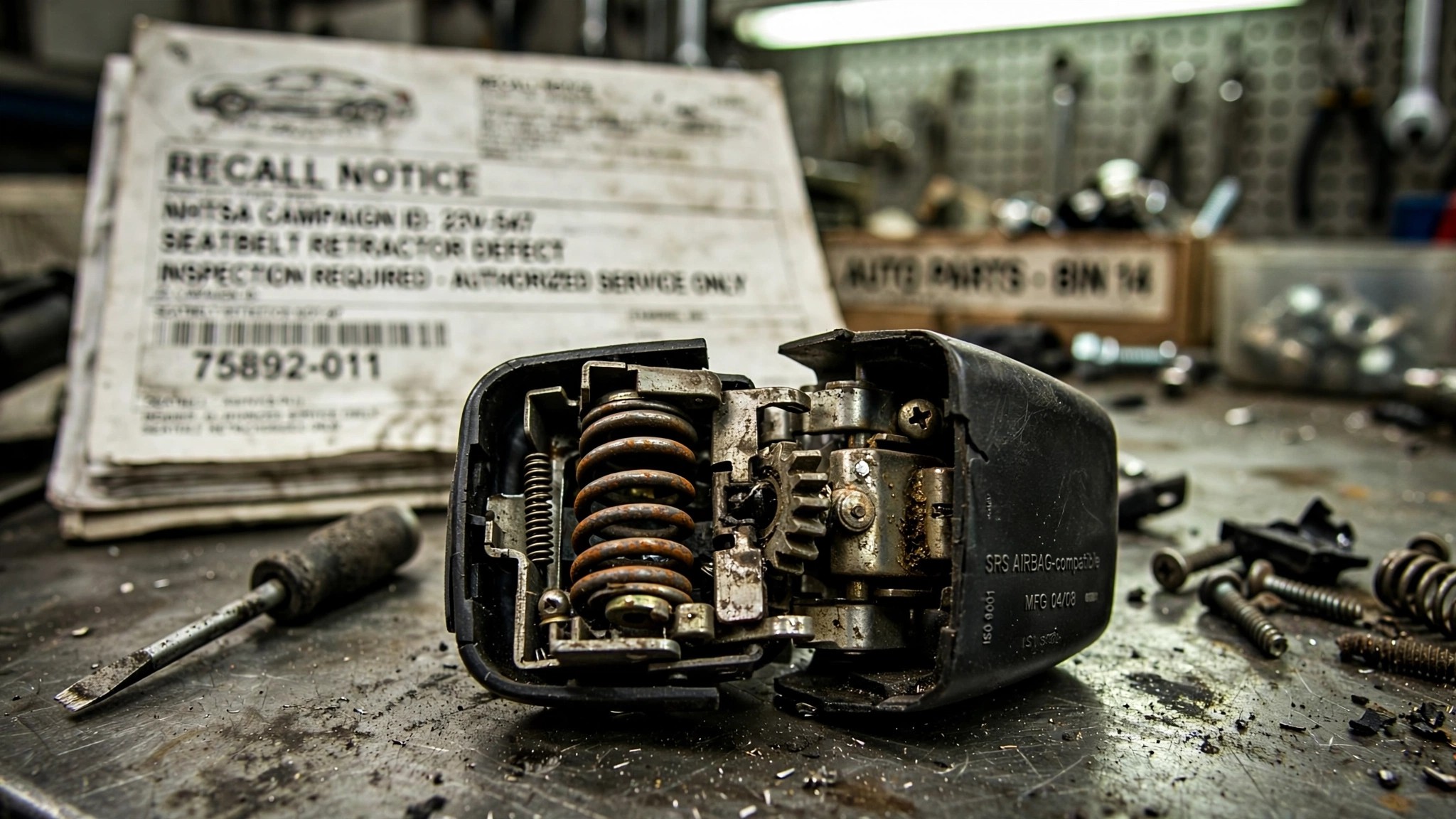
Nils Bohlin patented the three-point seatbelt for Volvo in 1959. Sixty-seven years later, five automakers have recalled over one million vehicles because they still cannot manufacture seatbelts that work correctly.
Ford leads the parade with 419,967 Expeditions and Lincoln Navigators from the 2018 through 2022 model years, their ZF Lifetec pretensioner assemblies harboring a propellant that corrodes its own detonator in hot climates. The propellant degrades, eats through the squib pin and bridgewire, and either fires the pretensioner when nobody asked it to or refuses to fire when you need it most. Ford knows about one injury so far. Ford also knows this is their third attempt at fixing the same defect, because this recall supersedes two prior campaigns from 2024 and 2025 that failed to solve the problem.[1]
Kia went next. Or rather, Kia went again. The 2027 Telluride picked up a recall for a driver's seatbelt emergency locking retractor that may not lock, covering crossovers built between March 24 and May 12, 2026. That is the Telluride's second seatbelt recall in three months; 14,000 units had already been called back in March because the center seatbelt anchor buckle would not latch. Tack on 85,000 2025 Tellurides recalled for seat back frames that become hazardous in a rear-end collision, and you have a family hauler whose restraint systems are failing at every attachment point simultaneously.[2]
Hyundai and Genesis recalled roughly 300,000 vehicles for seatbelt issues in April. Mercedes-Benz issued a recall for 2026 GLE and GLS models built at its Alabama plant because seatbelt anchor bolts may not have been torqued to specification. Audi had its own seatbelt recall. So did Rivian.[3]
Those percentages deserve attention, because they quantify what breaks when the seatbelt breaks. NHTSA estimates a properly functioning seatbelt reduces your fatality risk by 45 percent in a passenger car and 60 percent in a light truck. In 2024, seatbelt use stood at 91.2 percent nationally, yet 48 percent of the 22,713 passenger vehicle occupants killed that year were unrestrained. The math is brutal and direct: a seatbelt is the single largest variable between living and dying in a crash, and roughly 11,800 belted occupants survived in 2024 specifically because the device worked as designed. A defective pretensioner, an unbuckled anchor, a bolt torqued to whatever-felt-right turns that 45 percent shield into theater.[4]
The Ford Expedition accounts for 1,515 occupant deaths and 2,641 fatal crashes in FARS data from 2014 through 2023, yielding a 57.4 percent crash lethality ratio. That is not a small vehicle with a fragility problem. It is a 5,500-pound body-on-frame truck whose occupants die at a rate of 2.31 per 100 million vehicle miles traveled. When the one device standing between impact and ejection malfunctions because a tier-two supplier changed propellant chemistry and nobody noticed for five production years, you have a supply chain problem masquerading as an engineering problem.[5]
What makes this a systemic failure rather than a string of bad luck is the diversity of failure modes. Ford's issue is chemical degradation of a pyrotechnic propellant. Kia's is a mechanical locking mechanism that fails to engage, plus a buckle that will not latch. Mercedes is a torque specification error on the factory floor. These are not the same defect propagating through a shared supplier. They are independent quality failures in the most mature automotive safety component in existence, a device whose core design has not changed meaningfully since Bohlin's patent drawings, occurring across five different manufacturing operations on three continents within the same six-month window.
Ford has issued 40 recalls in 2026, more than the next two automakers combined, and its warranty expenditures doubled as a share of revenue between 2010 and 2020. The company spent $4.8 billion on warranty repairs in 2023, roughly $1,203 for every vehicle sold.[6] But Ford is merely the loudest symptom. The broader question is whether seatbelt manufacturing quality has degraded industry-wide as automakers squeeze costs from suppliers and tier-two subcontractors chase the cheapest propellant, the fastest bolt-runner cycle time, the thinnest retractor housing that will still pass certification testing.
Check your VIN at nhtsa.gov/recalls. If you drive a 2018 through 2022 Expedition or Navigator, a 2025 through 2027 Kia Telluride, a 2026 Mercedes GLE or GLS, or a recent Hyundai or Genesis, do it today. A seatbelt recall is not the kind you ignore until the next oil change, because when it matters, there is no second try and no firmware update and no over-the-air patch. It either holds you in the seat or it does not.
Sources & References
- NHTSA recall filing; autoevolution, “Ford Recalls 419,967 Expedition and Lincoln Navigator Vehicles for Seatbelt Retractor Issue,” June 2026. nhtsa.gov
- Autoblog, “2027 Kia Telluride Faces Another Recall As Driver’s Seat Belt Can Lock Up,” June 2026. nhtsa.gov
- Autoblog, “Multiple Seatbelt Issues for Multiple Automakers,” June 2026; autoevolution, Mercedes GLE/GLS seatbelt bolt recall, June 2026. nhtsa.gov
- NHTSA, “Seat Belt Safety: Buckle Up America,” 2024 data. Kahane, C.J. (2015), “Lives Saved by Vehicle Safety Technologies.” nhtsa.gov
- NHTSA FARS 2014–2023. Ford Expedition: 1,515 deaths, 2,641 fatal crashes, rate 2.31/100M VMT. nhtsa.gov
- The Street, “Ford recalls 420,000 SUVs for a dangerous issue,” June 2026; Warranty Week data on Ford repair costs. thestreet.com
Limitations: This analysis counts named seatbelt-related recalls in the first half of 2026 but may not capture all NHTSA campaigns involving restraint subcomponents categorized under different defect codes. The “over one million” total combines confirmed recall populations from Ford (419,967), Hyundai/Genesis (~300,000), Kia (multiple campaigns), and Mercedes but relies on secondary reporting for the Hyundai/Genesis figure. FARS data covers 2014 through 2023 and cannot isolate crashes where seatbelt defects contributed to the outcome, only crashes where restraint use was recorded.
Counterargument at full strength: One could argue this is not an epidemic but statistical noise amplified by recall transparency. NHTSA processed over 1,000 recall campaigns in 2025 alone, and seatbelt components appear in a predictable fraction of any random sample. Vehicles are more complex than ever, warranty reporting is more aggressive, and automakers are issuing recalls preemptively rather than waiting for crashes. The fact that five brands disclosed seatbelt issues simultaneously might reflect improved detection systems and a lower tolerance for risk rather than declining manufacturing quality. That argument deserves weight, but it does not explain why Ford needed three attempts to fix the same pretensioner, nor why Kia accumulated three distinct restraint failures in a single model within twelve months.