The UN Just Set the Bar for Self-Driving Cars: ‘As Good as a Competent Human.’ FARS Data Shows That’s Twice as Hard as It Sounds.
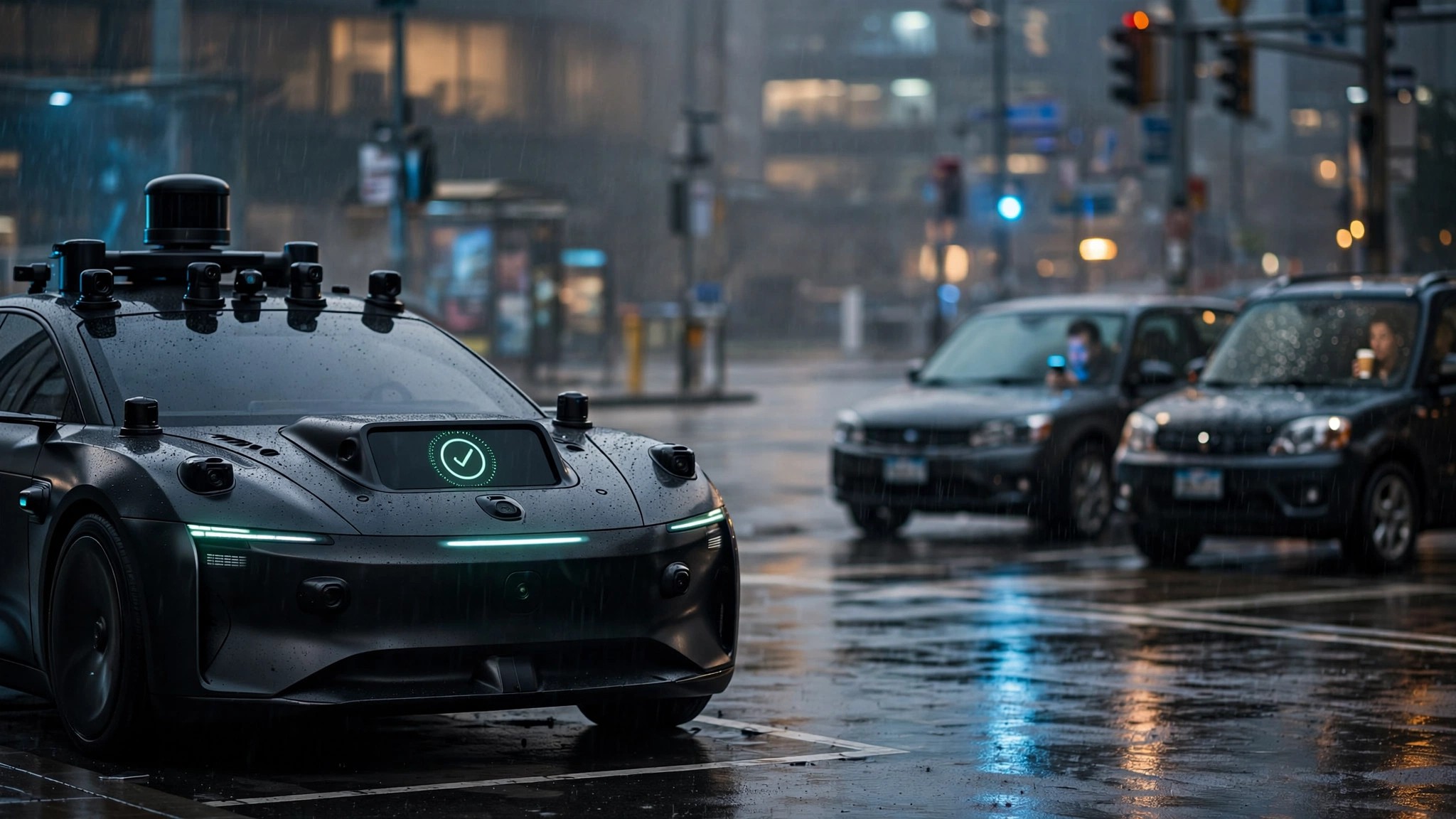
Yesterday, the United Nations Economic Commission for Europe adopted the first global regulatory framework for fully driverless vehicles.[1] The headline requirement sounds reasonable: automated driving systems must demonstrate performance that “matches or exceeds that of a competent human driver.” Backing that up requires simulation, track testing, and real-world trials. Canada, China, the EU, Japan, the UK, and the United States all signed on, and it takes effect in about a month.
One small problem with that standard. Nobody defined “competent.”
Every AV company cites the same number: 1.10 fatalities per 100 million vehicle miles traveled, NHTSA’s 2025 blended rate for all American drivers.[2] Beat that and you can claim your robot is safer than a person. Waymo does this, Tesla does this, and Cruise did this before the curb incident in San Francisco. It is a flattering comparison, because the denominator includes every driver on every road in the country, including the ones who probably should not have been there at all.
According to NHTSA, roughly 28% of all U.S. traffic fatalities involve an alcohol-impaired driver with a blood alcohol concentration at or above 0.08.[3] Another 8–9% involve distracted driving, and about 29% involve speeding. These categories overlap, but conservatively, around half of all fatal crashes involve a driver doing something that no reasonable person would call “competent.” Strip those fatalities from the numerator and recalculate with the same VMT, and the competent-driver fatality rate drops to somewhere between 0.55 and 0.77 per 100 million miles, depending on how broadly you define “competent.”
That is 28 to 50 percent harder than the bar most AV companies claim to clear.
Our FARS toxicology data (2014–2023, 490,736 drivers in fatal crashes across 307 vehicle models) puts finer resolution on the problem. One in five drivers killed in a fatal crash tested positive for alcohol, drugs, or both, and the breakdown by vehicle class is remarkably stable: 22.5% impairment for sports cars, 20.4% for sedans, 20.1% for pickups, 19.5% for SUVs, 18.1% for vans.[4] No vehicle class in America dips below 18%. Human incompetence has a floor, and it barely varies by what you drive.
When the UN says “competent human driver,” they are describing someone who is sober (eliminating 20% of the fatal-crash population), attentive (eliminating another slice), and obeying traffic laws (eliminating yet another). Stacking those filters produces a driver who is roughly twice as safe as the American average. Brussels did not set the bar at “better than a human.” They set it at “better than the best half of humans,” and most AV companies are benchmarking against the entire pool, including the worst fifth.
There is a counterargument, and it deserves its full weight: removing impaired drivers from the road does not remove their share of fatalities in a clean subtraction. Some impaired drivers die in crashes they did not cause, and some crashes involving sober drivers would not have happened if the drunk driver had not been on the road to serve as a target. Interaction effects are nonlinear and nobody has cleanly isolated them, which means our estimate of 0.55–0.77 is directional, not dispositive.
Distraction reporting widens the uncertainty further: NHTSA attributes 8–9% of fatal crashes to distraction, but that figure relies on police officers identifying phone use or inattention at a crash scene, a task roughly as reliable as diagnosing a concussion over the phone, and the actual distraction contribution is almost certainly higher. If so, the competent-driver rate may be lower still, and the bar even harder to clear.
What this means for you: When an AV company tells you their vehicle is “X times safer than a human driver,” ask which human. If they are comparing to the 1.10 national rate, they are taking credit for not driving drunk, not texting, and not doing 90 in a school zone. A Waymo that matches 0.55 per 100M VMT has done something genuinely impressive; a Waymo that matches 1.10 has done the equivalent of outrunning a guy with a broken ankle and calling itself fast. Until someone adds three words to the UN regulation and defines “competent,” the word is a Rorschach test, and every AV company will read it the way that makes their numbers look best.
Sources & References
- United Nations Economic Commission for Europe, “New global rules clear the road for driverless vehicles,” June 24, 2026. news.un.org
- NHTSA, “2025 Traffic Death Estimates & 2024 FARS,” June 2026. nhtsa.gov
- NHTSA, Traffic Safety Facts: Alcohol-Impaired Driving. nhtsa.gov
- NHTSA, Fatality Analysis Reporting System (FARS), 2014–2023, toxicology cross-tabulation by vehicle class. nhtsa.gov